
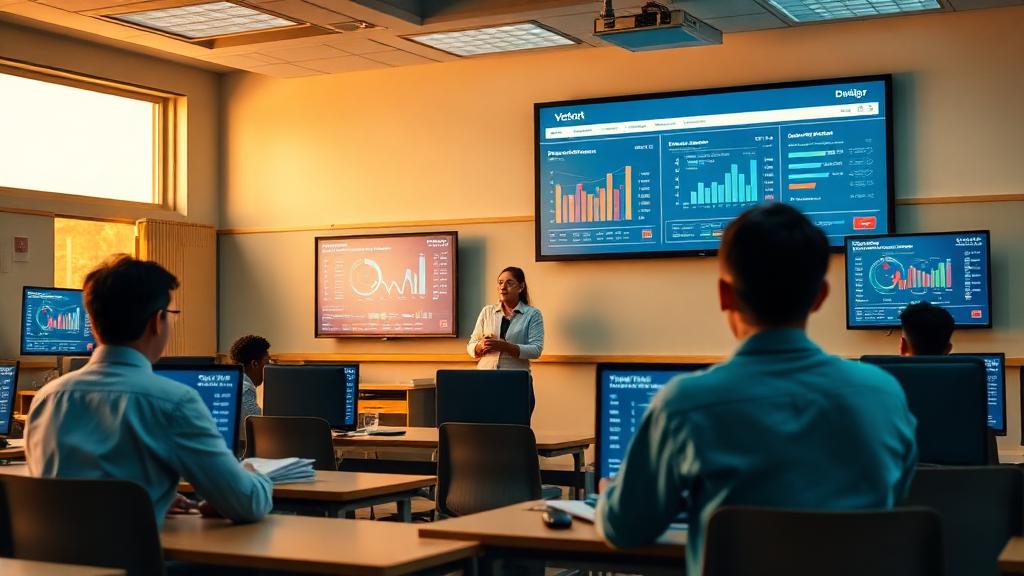
Most schools do not lack data. They lack timely data in a form a teacher can act on before a term ends. iTrack was designed around that gap: continuous signals on progress, attendance and mastery, surfaced to the people who can intervene while intervention still changes the outcome.
Key insights
- Continuous progress signals replace end-of-term snapshots.
- Teachers get early indicators for intervention, not just reports.
- Outcome dashboards align schools, parents and leadership on one view.
Continuous signals instead of end-of-term snapshots
Traditional reporting cycles reveal problems after the window to fix them has closed. iTrack collects evidence continuously — formative checks, assignment quality, participation and attendance — and rolls it into a mastery view per student, per learning objective.
Because the view is objective-level rather than subject-level, a teacher can see that a class is comfortable with equations but not with word problems, and reteach precisely that.
Early warning that names the intervention
An alert is only useful when it suggests an action. iTrack combines risk indicators — falling attendance, declining assessment trend, missed submissions — into a ranked list of students who need attention, together with the specific objective that is slipping.
Schools using this workflow typically move from reactive parent meetings to scheduled, evidence-backed interventions, which is a far easier conversation to have with families.
- Risk scoring across attendance, submission and mastery trends
- Objective-level diagnosis, not a generic 'at risk' flag
- Intervention logging so the school can see what actually worked
One view for teachers, leadership and parents
Alignment breaks down when each stakeholder reads a different report. iTrack publishes role-appropriate views from the same underlying record: teachers see class and objective detail, leadership sees cohort and grade trends, and parents see their child's progress with plain-language context.
For district and ministry programmes, the same spine aggregates upward, so governance shifts from periodic audit to continuous steering.
Implementation without disruption
iTrack integrates with existing school information systems and assessment tools rather than replacing them. Typical rollouts begin with one grade band and two subjects, prove the intervention loop over a term, and then extend school-wide.
What this means for your programme
Monitoring only improves outcomes when it shortens the distance between a signal and a teacher's next lesson. That is the design brief iTrack was built against.
If any of the themes above map to a challenge you are solving, our team can share how comparable programmes were designed, deployed and measured at scale.